How Can Bookkeeping Automation AI Help You Scale Finance Operations in 2026


Growing companies face a finance problem that spreadsheets cannot solve.
Transaction volumes increase every month. Payment tools multiply across cards, gateways, payroll systems, and SaaS subscriptions. Cross-border operations add currency conversions, tax rules, and entity-level reporting. What worked when you processed 200 transactions a month starts breaking at 2,000.
When reconciliation stretches into week two or three of the next month, leadership loses real-time visibility into burn and runway. Investor updates rely on outdated numbers. Errors compound quietly across ledgers, especially when manual categorization and copy-paste workflows dominate the process.
Bookkeeping automation AI addresses this pressure by reducing repetitive accounting work while strengthening reporting reliability. Instead of relying only on static rules, AI systems learn from transaction history, detect anomalies, and reconcile data continuously. In this guide, you will see how bookkeeping automation AI works, how it improves financial visibility, and how to implement it without compromising compliance or oversight.
What is Bookkeeping AI Automation?
Bookkeeping automation AI is a finance system that uses machine learning to process transactions, categorize expenses, and reconcile accounts with minimal manual input. Instead of relying only on preset rules, it studies your historical financial data. As transaction volume grows, the system becomes better at identifying patterns, classifying expenses, and spotting inconsistencies.
Traditional accounting software can automate repetitive tasks, but it depends heavily on fixed rules. For example, you might set a rule that all payments to a specific vendor go under “Software Expenses.” That works until the vendor changes services or you add new cost categories. Bookkeeping automation AI adapts automatically. It learns from corrections, recognizes new spending behavior, and refines its accuracy over time. The result is a system that scales with your business rather than requiring constant manual adjustments.
Here is a simple comparison:
How AI Handles Data Extraction, Categorization, and Reconciliation
Bookkeeping automation AI works across three core layers of finance operations: extracting financial data, categorizing transactions intelligently, and reconciling records continuously.
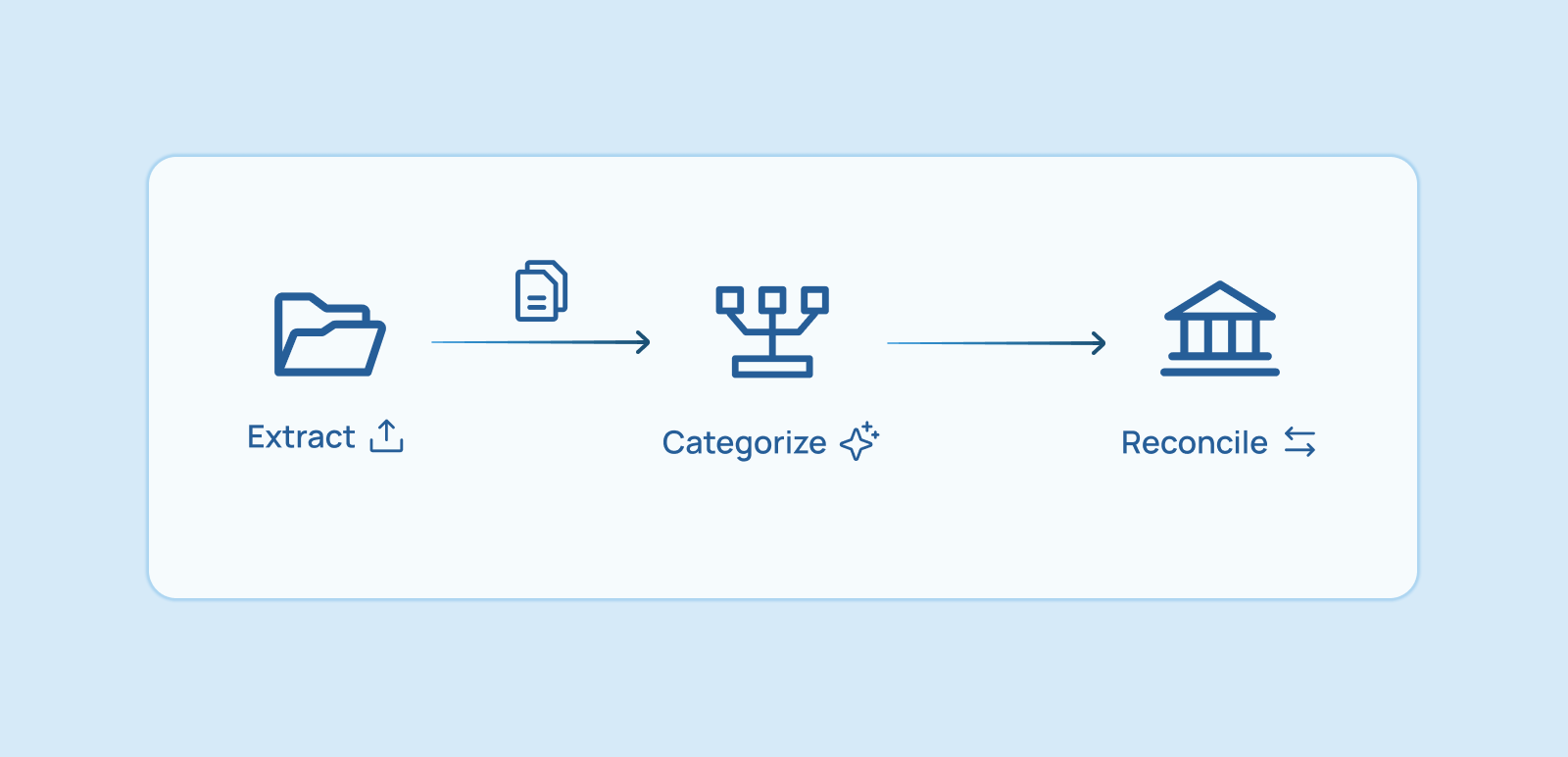
Together, these layers reduce manual effort while improving accuracy and visibility.
i) AI-Powered Data Extraction from Invoices and Receipts
AI systems use Optical Character Recognition (OCR) combined with structured data models to read invoices, receipts, and bills. Instead of manually typing vendor names, amounts, or tax details, the system captures the information directly from uploaded documents or email attachments.
- Captures vendor names, invoice numbers, and payment terms automatically
- Extracts tax amounts, line items, and currency details
- Reduces manual entry errors and missing data fields
This ensures consistent data entry even when document formats vary across vendors or countries.
ii) Machine Learning for Smarter Transaction Categorization
Once data is captured, machine learning models analyze historical bookkeeping records to categorize each transaction. Rather than applying only static rules, the system identifies patterns across vendors, payment descriptions, and recurring expenses.
- Learns recurring vendor behavior and expense patterns
- Adapts when new expense categories or services appear
- Flags unusual or inconsistent entries for review
For example, if a vendor previously categorized under “Software” begins charging for consulting services, the system can detect the change and request verification.
iii) Automated Bank Reconciliation in Real Time
Traditional reconciliation happens at month-end. AI-enabled systems reconcile continuously by matching bank feeds with ledger entries as transactions occur. This reduces backlogs and shortens close cycles.
- Matches transactions with bank feeds daily
- Detects duplicate entries before they affect reports
- Surfaces discrepancies instantly for review
Instead of discovering errors weeks later, finance teams can correct issues in real time. This shift from periodic to continuous reconciliation improves both speed and confidence in financial reporting.
Improve Reporting Speed and Financial Visibility with AI Automation
When bookkeeping moves from manual review to continuous processing, reporting changes fundamentally. Instead of waiting for month-end reconciliation to understand cash position or burn rate, finance teams can access near real-time data. This shift improves decision-making, investor communication, and internal planning.
i) Move from Month-End Reporting to Continuous Visibility
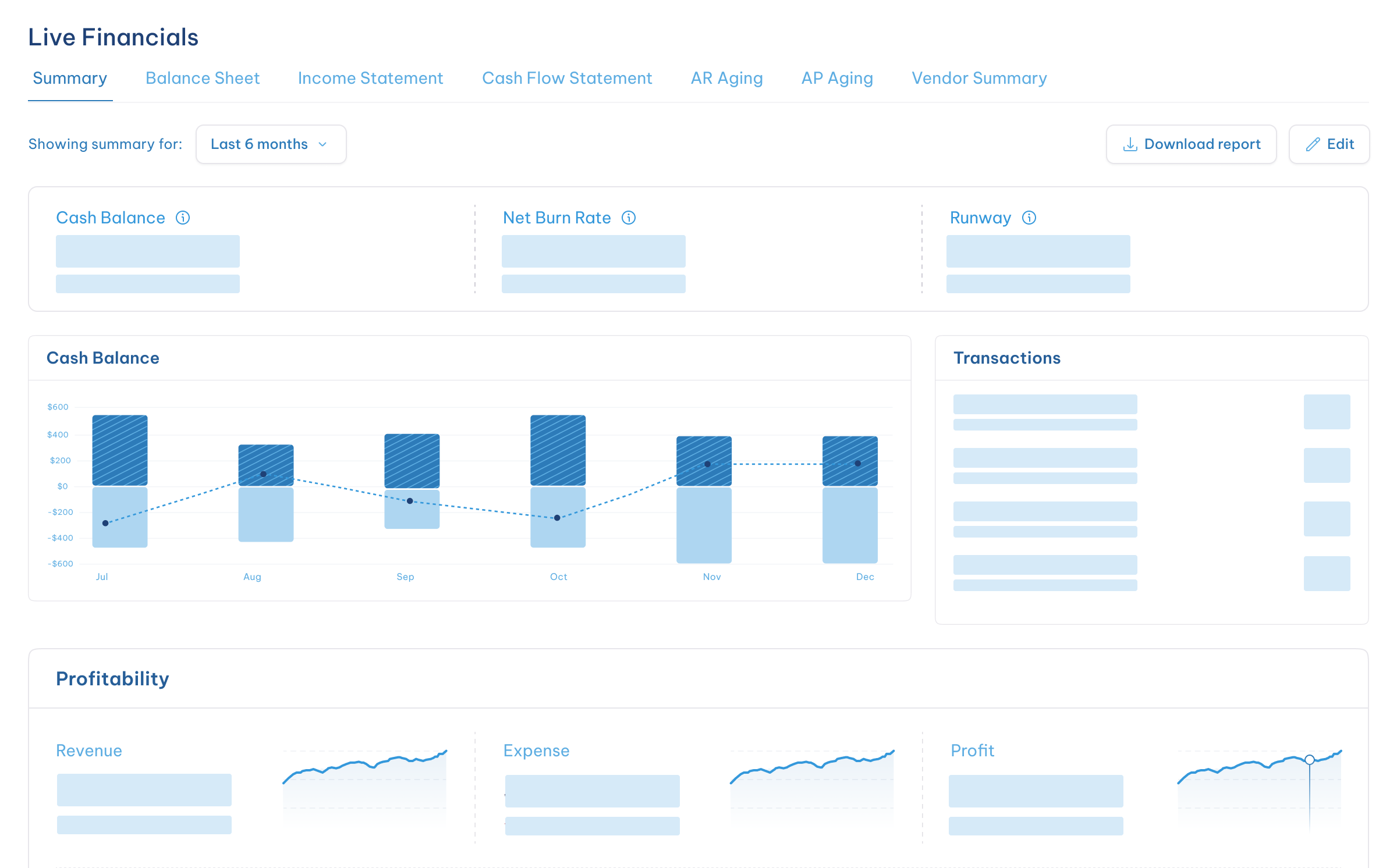
Traditional reporting depends on completed reconciliations. If entries are delayed, financial reports are delayed. AI automation processes transactions daily, which shortens close cycles and improves forecasting accuracy.
- Track daily cash flow instead of relying on monthly summaries
- Close books faster with fewer pending reconciliations
- Calculate runway in real time based on updated expense data
For example, if a company processes 3,000 transactions per month and manual reconciliation takes 10 days, leadership operates on outdated numbers for one-third of the month. With automated daily reconciliation, reporting lag can shrink to one or two days.
ii) Reduce Manual Errors Across High-Volume Transactions
As transaction volume grows, manual entry increases the risk of duplicate postings, misclassification, and reconciliation gaps. AI systems reduce these risks by standardizing categorization and flagging inconsistencies early.
- Eliminate duplicate data entry across systems
- Reduce dependence on spreadsheets for tracking adjustments
- Minimize reconciliation delays caused by mismatched records
Fewer manual touchpoints mean fewer silent errors that distort financial reporting.
iii) Streamline Expense Management and Policy Enforcement
Expense tracking becomes harder when teams expand across locations or currencies. AI automation improves visibility into employee spending and vendor payments while maintaining structured approval flows.
- Accelerate reimbursements with automated categorization
- Enforce spending policies through pattern-based checks
- Maintain detailed audit trails for every transaction
With consistent transaction tracking, companies gain clearer insight into operational spending and can identify cost trends earlier.
Ensure Accuracy and Data Security in AI-Driven Finance
Automation increases speed, but finance teams care most about accuracy and control. Bookkeeping automation AI is designed to improve reliability over time while maintaining strict security standards. The key is combining machine intelligence with structured oversight.
How Accurate is AI Transaction Categorization?
AI categorization improves as the system processes more historical data and receives feedback from reviewers. Early-stage implementation may require more manual validation, but accuracy rises as patterns become clearer.
- Accuracy improves with transaction history and correction feedback
- Anomaly detection highlights hidden errors that manual review may miss
- Human review layers strengthen reliability for complex or high-value transactions
For example, if the system initially categorizes 85 percent of transactions correctly, continuous learning and review cycles can raise that rate significantly within a few months.
Security Controls in AI Accounting Systems
Financial data requires strict protection. Modern AI bookkeeping systems use enterprise-grade safeguards to protect sensitive information while maintaining audit transparency.
- End-to-end encryption for data in transit and at rest
- Role-based access controls to limit internal permissions
- SOC 2 compliant infrastructure for operational security
- Detailed audit logs that track every change and adjustment
Automation should never reduce control. Instead, it should create clearer documentation and traceability across your finance processes.
How to Implement Bookkeeping Automation AI Without Disrupting Operations
Adopting bookkeeping automation AI does not require a full finance overhaul. The goal is structured transition, not sudden replacement. A phased rollout helps finance teams maintain reporting continuity while the system learns and stabilizes.
Here is a practical five-step framework:
Step 1. Review Your Current Bookkeeping Workflows
Start by documenting how transactions move today. Identify manual touchpoints, reconciliation delays, spreadsheet dependencies, and approval gaps. This baseline helps you measure improvement later.
Step 2. Clean and Standardize Historical Financial Data
AI systems learn from past transactions. If historical data contains inconsistent categories, missing fields, or duplicated entries, performance suffers. Standardize chart of accounts, correct misclassifications, and remove outdated rules before migration.
Step 3. Integrate Bank Feeds and Expense Platforms
Connect primary bank accounts, payment gateways, payroll tools, and expense management systems. Continuous data feeds allow the AI engine to reconcile transactions daily instead of in batches.
Step 4. Assign Oversight for Exception Handling
Not every transaction should be automated without review. Assign a finance lead to monitor anomalies, approve edge cases, and validate large or unusual entries. This oversight layer strengthens accuracy.
Step 5. Monitor Performance and Refine System Rules
Track categorization accuracy, reconciliation timing, and reporting speed. Review flagged transactions regularly and provide feedback to improve model performance.
A realistic implementation timeline often looks like this:
- Phase 1: Setup (Weeks 1–2) - Workflow review, data cleanup, and system integration
- Phase 2: Training (Weeks 3–4) - AI processes transactions with active human review
- Phase 3: Optimization (Weeks 5–8) - Accuracy improves, reconciliation becomes continuous, reporting stabilizes
With structured rollout and active monitoring, automation strengthens finance operations without interrupting day-to-day accounting.
Strengthen Cross-Border Bookkeeping with Inkle
Automation improves processing speed, but it does not automatically guarantee regulatory alignment. Companies operating across the US and India must align bookkeeping with tax filings, reporting standards, and entity-level compliance requirements. Clean transaction data is only useful when it maps correctly to statutory obligations.
For growing startups, this becomes even more important when raising capital or preparing for audits. Investors expect structured financial statements, consistent categorization, and documented controls. Automation can support this structure, but oversight ensures that financial records meet jurisdiction-specific rules.
Here is how Inkle supports structured automation with compliance alignment:
- Automated transaction processing combined with finance-team review
- Alignment with US and India reporting and tax requirements
- Clean, investor-ready books for board and fundraising updates
- Audit-ready documentation with traceable transaction history
If your company is scaling across entities or currencies, assess whether your bookkeeping system supports both automation and compliance readiness.
Book a demo with Inkle to see how AI-driven bookkeeping combined with expert oversight can support accurate, compliant, and investor-ready finance operations.
Frequently Asked Questions
How accurate is bookkeeping automation AI for growing companies?
Accuracy depends on data quality and review processes. Most systems achieve high baseline accuracy once historical transactions are trained into the model. Performance improves as the AI processes more data and receives corrective feedback. However, human review remains important for high-value, unusual, or complex transactions.
Can AI bookkeeping support multi-currency transactions?
Yes. Modern systems process exchange rates automatically and record currency conversions based on transaction dates. They can track realized and unrealized gains or losses. That said, cross-border tax treatment and reporting standards still require oversight to ensure correct financial statement presentation.
Is bookkeeping automation AI cost-effective for early-stage startups?
It becomes cost-effective once transaction volume begins to strain manual processes. If a startup processes only a few hundred transactions per month, basic automation may suffice. As volumes increase or operations span multiple entities, AI-driven reconciliation and categorization reduce manual workload and reporting delays.
How long does implementation typically take?
Most implementations take between four and eight weeks. The timeline depends on data cleanliness, number of integrations, and complexity of reporting requirements. A phased rollout with active monitoring helps stabilize accuracy faster.
What risks should companies consider before adopting AI bookkeeping?
Poor historical data can reduce categorization accuracy during early stages. Lack of defined oversight may allow anomalies to go unchecked. Integration gaps between payment tools, banks, and accounting systems can also create reconciliation mismatches. Structured implementation and clear review roles reduce these risks.
Does AI bookkeeping software replace tax advisors?
No. Bookkeeping automation focuses on recording and organizing financial transactions. Tax planning, filing strategy, and regulatory interpretation require professional tax expertise. AI can support documentation and reporting accuracy, but it does not replace compliance strategy or advisory judgment.
In this article


.png)